| Feature | Details |
| Estimated Time | Weekend Project (12–16 Hours) |
| Estimated Cost | $100 – $150 (Varies by lumber choice) |
| Required Tools | Miter saw, Drill/Driver, Jigsaw, Orbital sander, Tape measure, Clamps |
| Difficulty Level | Confident Beginner / Intermediate |
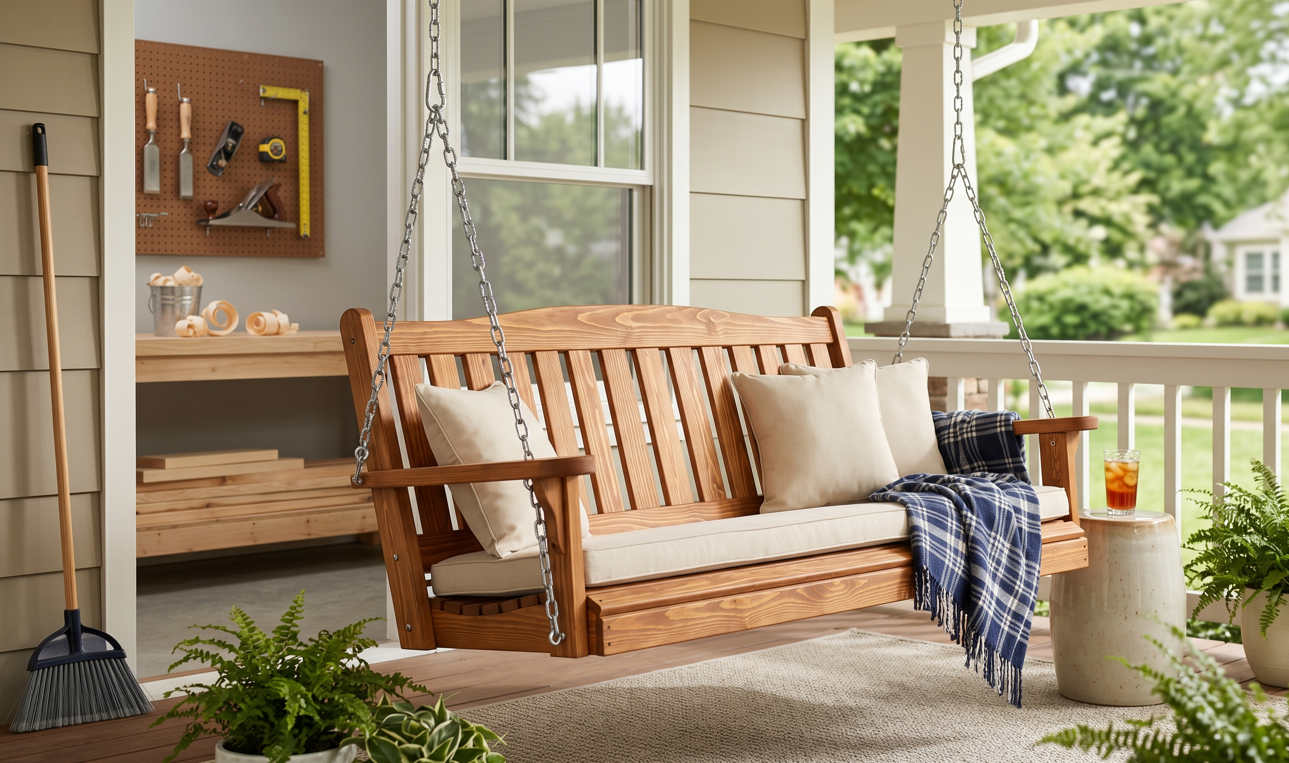
Building a classic wooden porch swing is the weekend project that permanently changes how you use your porch — a piece of furniture that transforms a plain covered porch into a genuine outdoor sanctuary. There is a profound, almost magnetic pull to working with wood. It isn’t just about assembling boards; it’s about taking a raw, organic material that once stood tall in a forest and giving it a new life — a soul, if you will — as a functional piece of art.
Don’t let the romance of the craft intimidate you. Woodworking is for everyone, and this classic wooden porch swing is the perfect weekend project to prove it. You don’t need a shop filled with $10,000 cast-iron machinery to pull this off. With a few basic power tools, a stack of dimensional lumber, and a willingness to make a little sawdust, you can build an heirloom-quality swing that will transform your porch into a sanctuary. Let’s dive into the plans and get building.
What these free classic wooden porch swing plans cover
- Full shopping list and cut list using standard big-box lumber
- Step-by-step frame and seat assembly — supports, aprons, and slats
- How to build, shape, and attach the armrests
- Through-bolt hardware installation for safe, rated hanging
- Outdoor finishing — pre-stain, spar urethane, and edge refinement
⏱ Build time: 12–16 hours · Difficulty: Confident beginner / intermediate
The Shopping List
You can grab everything you need for this build at your local US big-box home center like Home Depot or Lowe’s. Take your time sifting through the lumber stacks to find the straightest, clearest boards available.
| Lumber & Materials | Notes |
|---|---|
| (2) 1×3 boards @ 6ft | Select Pine or Oak — vertical rails |
| Exterior wood glue (Titebond III) | All joints |
| 1 lb. box of 2½″ exterior deck screws | Frame assembly |
| 1 lb. box of 1¼″ exterior deck screws | Slat attachment |
| Heavy-Duty Porch Swing Hanging Kit (rated 500+ lbs) | Hanging hardware |
| Wood Filler (Stainable/Paintable) | Screw head filling |
| Tools |
|---|
| Miter saw or circular saw |
| Jigsaw (for curves and tapers) |
| Cordless drill / impact driver combo |
| Random Orbital Sander |
| Tape measure, speed square, trigger clamps (at least two 24″) |
The Cut List
Precision pays off. Ensure your saw is dialed in to a perfect 90 degrees before tackling these cuts.
| Piece | Qty | Dimension |
|---|---|---|
| From 2×4 stock | ||
| Seat supports | 3 | 20″ |
| Back supports | 3 | 24½″ (15° angle on bottom edge) |
| Front apron | 1 | 55″ |
| Back support cleat | 1 | 55″ |
| Vertical armrest supports | 2 | 11¼″ |
| From 1×4 stock | ||
| Seat and back slats | 14 | 60″ |
| Armrests | 2 | 23½″ |
The Step-by-Step Build
Step 1: Prepping the Stock and Cutting the Frame
Begin by cutting your 2×4 seat supports and back supports to length. For the seat supports, mark 1″ down on the front edge and taper the cut back to the middle of the board to relieve knee pressure. For the back supports, cut the bottom edge at a 15-degree angle.
Moisture Acclimation and Equilibrium Before you make that first crosscut, let’s talk about Equilibrium Moisture Content (EMC). Wood is a hygroscopic material, meaning it constantly acts like a sponge, absorbing and releasing moisture to reach an equilibrium with the relative humidity of its environment. When you bring dimensional lumber home from the racks of a big-box store, its internal moisture gradient is often wildly out of balance with your outdoor environment. If you mill, cut, and assemble this wood immediately, the inevitable drying process will cause unequal tangential and radial shrinkage. This manifests as warping, twisting, and bowing that can completely rip your joints apart.
By letting the lumber acclimate on stickers (thin spacer strips) in your shop or on your porch for 7 to 10 days, you allow the fibers to settle. You are essentially letting the wood do its moving before you trap it in a rigid geometric frame.
Step 2: Assembling the Seat and Back Supports
Apply a generous bead of exterior wood glue to the 15-degree angled face of the back support. Clamp it flush to the back of the seat support and drive three 2 1/2″ exterior screws to secure the joint. Repeat this to create three identical support brackets. Connect these brackets using the 55″ front apron and back cleat.
The Physics of the Mechanical Joint In traditional furniture making, we rely on the immense shear strength of long-grain to long-grain glue joints—think mortise and tenon. However, in outdoor framing with dimensional lumber, we are often forced into end-grain to side-grain assemblies. End-grain is essentially a bundle of microscopic straws; it wicks away glue rapidly, resulting in a starved, weak joint. Therefore, the glue here acts primarily as a localized sealant against moisture intrusion rather than a structural bond.
The true structural integrity of this swing relies entirely on the tensile and shear strength of your mechanical fasteners. By using 2 1/2″ exterior deck screws, we are embedding the threads deep into the dense latewood rings of the receiving board. We also stagger the screw placement to prevent them from acting as a wedge along a single continuous grain line, which would induce a catastrophic split under the dynamic load of a swinging body.
Step 3: Installing the Slats
Starting at the front apron, lay down your first 60″ 1×4 slat. Pre-drill and drive two 1 1/4″ screws into each of the three supports. Use a 1/4″ spacer between each subsequent slat as you work your way across the seat and up the backrest.
Tangential Movement and Cupping Dynamics The 1/4″ gap we leave between the slats isn’t just an aesthetic choice; it is a structural imperative dictated by seasonal wood movement. As the humidity swings from humid summers to dry winters, a 60-inch wide panel of solid wood will expand and contract across its width significantly. If we edge-joined these slats tightly, the expansion would cause the wood to buckle and rip the screws straight out of the frame. Furthermore, you must look at the end-grain of your 1×4 slats before screwing them down. Notice the curve of the annular growth rings.
Wood naturally wants to “cup” in the direction opposite the curve of these rings (it tries to straighten them out as it dries). By orienting the boards “bark side up” (so the rings look like a rainbow, not a smile), the edges of the board will press tightly down into the 2×4 framing over time, rather than curling up and creating an uncomfortable, splinter-prone edge.
Step 4: Crafting the Armrests
Secure the 11 1/4″ vertical 2×4 supports to the outside of the outermost seat frames. Cut a pleasing radius on the front of your 1×4 armrests using a jigsaw. Attach the armrests to the top of the vertical support and secure the back end to the side of the backrest frame.
Leverage and Load Path Distribution An armrest on a porch swing is subjected to complex torsional and downward forces. When a person leans heavily onto the front of the armrest to stand up, they create a significant bending moment. The vertical armrest support acts as the fulcrum, and the joint at the rear of the armrest (attached to the backrest) bears the brunt of the resultant upward tear-out force.
This is why we absolutely must pre-drill and drive our screws deeply into the side-grain of the backrest framing, rather than the end-grain. Furthermore, by letting the armrest overhang the vertical support by roughly an inch, we distribute the downward compressive load vertically through the 2×4 leg directly into the main seat frame, efficiently transferring the live load without relying solely on the shear strength of a few screws.
Step 5: Hardware and Hanging Installation
Drill 1/2″ holes completely through the 2×4 framing—two in the front seat supports, and two in the backrest supports. Insert heavy-duty eye bolts with washers on both sides, securing them tightly with nylon-insert lock nuts.
Shear vs. Pull-out Capacity Hanging a dynamic, moving structure that holds hundreds of pounds of human weight requires a strict adherence to hardware engineering principles. Never simply thread an eye screw blindly into the top edge of a 1×4 slat. The pull-out capacity of a threaded screw in softwood is highly variable and prone to failure under cyclic loading (the repetitive bouncing of the swing).
By drilling completely through the 3 1/2″ depth of the 2×4 structural frame and using a through-bolt configuration (an eye bolt with heavy steel washers and lock nuts on the opposing side), we completely eliminate pull-out failure. We transition the force into a compression load against the washers and a shear load across the solid steel shank of the bolt. This ensures that the wood matrix itself would have to catastrophically crush before the hardware could ever fail.
The Heritage Touch: Refining the Edges
A note from the traditional craftsman’s bench…
While modern random orbital sanders are marvels of efficiency, they often leave a sterile, manufactured feel to the wood, and their aggressive rotation can subtly dish out the softer earlywood while leaving the harder latewood proud. To elevate this swing from a weekend DIY project to a true piece of heritage craftsmanship, unplug the sander for a moment and pick up a sharp #4 smoothing plane or a simple cabinet scraper.
Run the hand plane along the sharp, 90-degree corners of your slats to create a crisp, continuous chamfer. This “breaking of the edges” is not only significantly faster than sanding, but the sheer cutting action of a sharpened iron severs the wood fibers cleanly, leaving a shimmering surface that no sandpaper can match. Follow this by taking a few light, curling shavings off the face of the armrests with a well-burnished cabinet scraper. The resulting tactile feedback—the smooth, undulating surface crafted by hand—is something you and your guests will feel every time you sit down. It connects the finished piece back to the maker’s hands.
Finishing & Protection
Outdoor furniture faces a brutal gauntlet: punishing UV radiation, driving rain, and wildly fluctuating temperatures. A proper finish is your swing’s only armor.
If you are using Pine and wish to stain it, you must apply a pre-stain wood conditioner first. Pine is notorious for absorbing stain unevenly, resulting in a blotchy, amateurish finish. The conditioner standardizes the porosity of the wood.
Once stained (or left natural, if using Cedar), you need a film-building topcoat. Do not use standard interior polyurethane; it dries rigid and will quickly crack, peel, and flake as the wood expands and contracts outdoors. Instead, apply three coats of an exterior-grade Spar Urethane. Spar urethane contains a higher ratio of oil to resin, allowing the finish to remain slightly flexible. It also contains heavy UV inhibitors. Apply the first coat thinned slightly with mineral spirits to promote deep penetration, then apply two full-strength coats, lightly scuff-sanding with 320-grit paper between applications for a glass-smooth finish.
Frequently Asked Questions
How much weight can a wooden porch swing hold?
What is the best wood for an outdoor porch swing?
How far off the ground should a porch swing be?
Final Thoughts and Next Steps
There you have it! You just built an incredible piece of furniture that is going to completely change how you use your porch. Seriously, grab a cup of coffee, sit down, and give it a test drive. You earned it. The best part about woodworking is that feeling of accomplishment every time you look at something and know you made it.
Now that your classic wooden porch swing is hanging and ready, you need somewhere to set that coffee. Our easy DIY farmhouse outdoor coffee table plans are the perfect companion build — same lumber, same pocket-hole method, same weekend commitment. For the full outdoor patio setup, check out the modular outdoor sectional and DIY slatted outdoor sofa to complete your outdoor living space.
For access to over 16,000 step-by-step plans covering projects at every skill level — each with a full cut list and materials guide — read our Ted’s Woodworking review to see what the full library includes
Keep making sawdust, stay safe, and welcome to the community here at Popular Woodworking Plans!
References
For further reading and to deepen your understanding of the concepts discussed in this build, I highly recommend adding these foundational texts to your shop library:
- Understanding Wood: A Craftsman’s Guide to Wood Technology by R. Bruce Hoadley
- Understanding Wood Finishing by Bob Flexner
- The Essential Woodworker by Robert Wearing
- Tage Frid Teaches Woodworking: Joinery by Tage Frid
Related Guides
- Easy DIY farmhouse outdoor coffee table plans
- DIY slatted outdoor sofa — free plans
- How to build a modular outdoor sectional
- DIY Adirondack chair — free weekend build
- Ted’s Woodworking review — 16,000 plans worth it?