Knowing how to choose a woodworking plan is one of the most important skills a beginner can develop — and one that most guides skip entirely. Pick the wrong plan and you’ll waste lumber, get frustrated, and potentially abandon the project halfway through. Pick the right one and the whole build flows from start to finish.
These eight tips cover everything that separates a good plan from a bad one — skill level matching, what every quality plan must include, how your local climate affects the wood and finish you choose, and how to use the woodworking community to vet plans before you commit.
The 8 tips covered in this guide
- Match your current skill level — not your aspirational one
- Demand a complete Bill of Materials and Cut List
- Look for high-quality, labelled diagrams
- Factor in your local climate and wood movement
- Pair the right finish to your environment
- Vet the plan through community reviews
- Respect copyrights and commercial licences
- Estimate the time and cost honestly
⏱ Reading time: about 8 minutes
What makes a woodworking plan worth following?
Before diving into the eight tips, it’s worth understanding what separates a plan worth building from one that will waste your time and lumber. A good woodworking plan is essentially a contract between the designer and the builder — it promises that if you follow the steps correctly, the finished piece will match the design. A bad plan breaks that contract somewhere in the middle.
The most common problems with poor woodworking plans are missing measurements, steps that jump from A to C without explaining B, diagrams that don’t match the written instructions, and materials lists that are incomplete or inaccurate. Any of these issues can stop a build in its tracks — often after you’ve already made irreversible cuts.
Knowing how to choose a woodworking plan that avoids these problems is what the following eight tips are designed to help you do.
Tip 1 — Match your current skill level, not your aspirational one
The most common mistake beginners make when choosing a plan is selecting one that’s slightly beyond their current abilities — because the finished piece looks impressive. The result is a project that stalls when a technique proves too difficult, wastes expensive lumber on failed attempts, and erodes confidence rather than building it.
How to assess skill level in a plan
Good plans clearly state their difficulty level. Look for indicators like:
| Skill Level | What to Look For | Typical Techniques | Example Projects |
|---|---|---|---|
| Beginner | Step-by-step detail, basic tools only, no advanced joinery | Butt joints, pocket holes, screws and glue | Toolbox, shelf, planter box, coffee table |
| Intermediate | Some assumed knowledge, router or table saw required | Dadoes, rabbets, half-laps, biscuit joints | Workbench, porch swing, cabinet |
| Advanced | Minimal hand-holding, complex joinery, multiple tool setups | Mortise and tenon, dovetails, hand-cut joinery | Heirloom furniture, complex cabinets |
A useful rule of thumb: choose a plan where you’re comfortable with at least 80% of the techniques. The remaining 20% provides the challenge that builds skill. If you’re unfamiliar with more than that, work on a simpler project first and come back to the ambitious one when your skills are ready.
For a full overview of the joinery techniques at each skill level, read our joinery techniques for beginners guide.
Tip 2 — Demand a complete Bill of Materials and Cut List
The second thing to check when learning how to choose a woodworking plan is the materials documentation.
Bill of Materials (BOM)
The Bill of Materials lists every component needed to complete the project — not just the timber, but the hardware, fasteners, adhesives, and finishing products. A complete BOM tells you exactly what to buy before you start, which means no mid-project trips to the hardware store and no unexpected costs.
Before purchasing or downloading any plan, check that the BOM includes lumber species and dimensions, sheet goods (plywood, MDF), hardware (hinges, drawer slides, screws, bolts), and finishing materials (sandpaper grits, stain, topcoat). If any of these are missing, the plan is incomplete.
Cut List
The Cut List breaks the project down into individual pieces, each with its finished dimensions — length, width, and thickness. A good Cut List tells you exactly how many pieces you need, what size to cut them, and which part of the project each piece becomes.
The Cut List also lets you plan your lumber yield efficiently. By knowing exactly how many pieces you need and their dimensions, you can lay out your cuts on each board to minimise waste. This is particularly important when working with expensive hardwoods where every board foot counts.
Always review the BOM and Cut List before starting a single cut. If you can’t follow the materials list without confusion, you won’t be able to follow the build instructions either.
Tip 3 — Look for high-quality, labelled diagrams
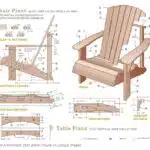
Woodworking is an inherently visual craft. Written instructions alone are rarely sufficient — you need clear, labelled diagrams that show exactly how each component fits together before you make a single cut.
What good diagrams look like
Quality plans include exploded view diagrams — 3D illustrations that show each component separated from the assembly so you can see exactly how it connects. Every piece in the diagram should be labelled with a part number or letter that corresponds to the Cut List. Dimensions should be clearly marked on the diagram, not just in the written instructions.
Photographs of the build in progress are an additional bonus — particularly for complex joinery steps where seeing the real wood being worked is more useful than any illustration. If a plan provides both diagrams and step-by-step photos, it’s a strong indicator of quality.
Red flags in diagrams
Watch for diagrams that show only the finished piece with no exploded views, dimensions that appear on diagrams but conflict with the written instructions, and illustrations that don’t match the described sequence of assembly. Any of these suggest the plan was designed to look good rather than to be followed.
Tip 4 — Factor in your local climate and wood movement
Wood is a hygroscopic material — it absorbs and releases moisture from the surrounding air, expanding across the grain in humid conditions and contracting in dry ones. A plan that works perfectly in a humid southern state may produce a cracked, buckled piece in a dry desert climate if wood movement isn’t accounted for in the design.
High humidity environments
If you live in a region with significant humidity — the Southeast, Pacific Northwest, or any coastal area — wood movement is a major design consideration. Look for plans that use techniques specifically designed to manage movement: figure-eight fasteners or wooden buttons for tabletop attachment, floating panels in cabinet doors and frames, and breadboard ends with elongated screw holes that allow the main panel to expand and contract.
Low humidity and arid environments
In dry climates, wood shrinks and can crack or split if it dries too quickly. Always allow new lumber to acclimatise in your workshop for at least one to two weeks before using it on a project. This gives the wood time to adjust to the ambient moisture level in your shop, reducing the risk of movement after the piece is built.
The acclimatisation rule
Regardless of your climate, acclimatising lumber before use is a woodworking basic for beginners that pays off on every project. Stack boards with spacers between them to allow air circulation on all faces. Check the moisture content with a moisture meter if possible — for indoor furniture, aim for 6-8% moisture content before cutting.
For a deeper understanding of how wood movement affects your projects, read our guide to understanding wood grain.
Tip 5 — Pair the right finish to your environment
Choosing the right finish is as important as choosing the right wood — and it’s closely tied to the environment the finished piece will live in. One critical point that most guides get wrong: finishes do not stop wood movement. They slow down moisture exchange, but the wood beneath will still expand and contract. Your design must account for movement regardless of the finish you apply.
Outdoor projects
Outdoor furniture is subjected to UV radiation, rain, temperature swings, and in coastal areas, salt-laden air. Standard interior finishes will fail quickly outdoors. Choose plans that specify exterior-appropriate finishes — marine-grade varnish, exterior polyurethane, teak oil, or penetrating exterior oils like Osmo UV Protection Oil. Reapply annually for maximum protection.
Indoor furniture
For indoor furniture that will see regular use — dining tables, coffee tables, workbenches — polyurethane is the most durable choice. It forms a hard film that resists scratches, moisture, and heat. For pieces that will be touched and handled frequently — chairs, bed frames, decorative items — an oil finish like Danish oil or hard wax oil is easier to apply and repair.
Food contact surfaces
Cutting boards, serving trays, and kitchen shelves require food-safe finishes only. Food-grade mineral oil and beeswax are the most accessible options and are widely available. Apply multiple thin coats and buff between each one. Never use polyurethane or varnish on surfaces that will contact food.
Tip 6 — Vet the plan through community reviews
Before committing to a plan — particularly a paid one — check what the woodworking community says about it. Fellow woodworkers who have built from the same plan are the most reliable source of information about whether it actually works. Vetting community reviews is an essential part of how to choose a woodworking plan that actually works.
Where to find plan reviews
Woodworking forums are the best source of honest plan reviews. Sawmill Creek and Wood Talk Online both have active communities where members discuss specific plans, report errors, and share their builds. Search the forum for the plan name or designer before buying — if there are known issues with the measurements or instructions, someone will have posted about it.
YouTube is another valuable resource. Search the project name and see if anyone has documented their build. Watching someone work through the same plan you’re considering reveals practical issues that written reviews don’t always capture.
What to look for in reviews
Positive reviews that mention accurate measurements, clear instructions, and a satisfying finished result are strong indicators of a quality plan. Negative reviews that mention dimensional errors, missing steps, or a finished piece that doesn’t match the design are red flags worth taking seriously.
One caveat: reviews on the plan seller’s own website are not reliable. Look for independent reviews on forums and YouTube where the reviewer has no commercial relationship with the plan creator.
Tip 7 — Respect copyrights and commercial licences
When you purchase or download a woodworking plan, you’re typically buying a licence to use it — not ownership of the design. Most plans sold online come with a personal use licence only, which means you can build the item for your own home or as a gift, but not to sell commercially.
Tip 8 — Estimate the time and cost honestly
Time and cost estimates listed on a woodworking plan are almost always optimistic. A plan that claims a 4-hour build assumes you’ve done the project before, your tools are already set up, and nothing goes wrong along the way.
Estimating lumber cost accurately
Take the Cut List from the plan and price it at your local hardware store or lumberyard before buying anything. Lumber prices vary significantly by region and species — a plan that estimates $40 in materials in one part of the country may cost $80 somewhere else. Price it yourself rather than trusting the figure in the plan.
Accounting for waste
Always buy 10–15% more lumber than the Cut List calls for. Every beginner makes at least one bad cut that wastes a board, and having spare material on hand prevents a mid-project hardware store run that kills your momentum. This is especially important with figured or expensive hardwoods, where a single ruined board can blow the entire project budget.
Knowing how to choose a woodworking plan that comes with realistic time and cost figures — or knowing to adjust for the ones that don’t — is what separates a smooth build from a frustrating one.
Personal use vs commercial use
If you intend to build items from plans to sell at craft fairs, on Etsy, or through any other commercial channel, you must ensure the plan comes with a commercial licence. Some designers offer commercial licences as an upgrade; others include them by default. When in doubt, contact the plan creator and ask directly — most are happy to clarify.
Free plans and copyright
Free plans available online are not automatically in the public domain. Many free plans are shared with a personal use licence — the same restriction applies. Scraped or aggregated plan collections that don’t clearly identify their sources often contain plans distributed without the original creator’s permission. Be cautious with large “plan dump” packages where the provenance of individual plans isn’t clearly stated.
Where to find quality woodworking plans
Now that you know how to choose a woodworking plan, here’s where to find ones that meet these standards:
| Source | Best for | Cost |
|---|---|---|
| Ted’s Woodworking | Beginners — 16,000+ plans, searchable library | $67 one-time |
| Woodsmith Magazine | Heirloom-quality furniture — professionally tested | Subscription or individual plans |
| Ana White | Farmhouse style, beginner-friendly, dimensional lumber | Free |
| Fine Woodworking | Advanced techniques, traditional joinery | Subscription |
| Woodworking for Mere Mortals | Beginners, basic tools, weekend projects | Free and paid |
For our full review of the Ted’s Woodworking plan library — including what’s inside, who it’s best for, and whether the $67 one-time price is worth it — read our Ted’s Woodworking review.
Apply these tips to your next build
Knowing how to choose a woodworking plan that matches your skill level, includes complete materials information, accounts for your climate, and comes from a reputable source is the foundation of a successful build. Apply these eight tips before committing to any plan and you’ll spend far less time fixing mistakes and far more time building.
Once you’ve chosen your plan, make sure you have the right tools and timber ready before you start. Our essential woodworking tools guide covers what to buy and in what order, and our guide to the best wood for beginner woodworking projects helps you choose the right species for your build.