The woodworking basics for beginners that matter most aren’t complicated — but most guides skip the practical detail that actually helps you avoid mistakes. This guide covers all 10 fundamentals in plain language, with real advice you can apply on your next project.
Whether you’re building your first shelf or planning a dining table, these are the skills and concepts that separate beginners who get frustrated from beginners who make real progress. Master these and you’ll have a foundation that carries you through every project for years to come.
The 10 woodworking basics covered in this guide
- Understanding wood types — hardwood vs softwood
- Wood movement and grain direction
- Essential joinery techniques and adhesives
- Tool proficiency and maintenance
- Safety practices every beginner must know
- Surface preparation for a professional finish
- Wood finishing techniques
- Project planning and blueprints
- Precision measuring and marking
- Problem-solving and adaptability
⏱ Reading time: about 9 minutes
Why woodworking basics for beginners matter more than tools
Most beginners focus on buying tools before they understand the fundamentals. That’s backwards. A beginner who understands wood grain, joint selection, and surface preparation will produce better results with basic tools than someone with a fully equipped shop but no foundational knowledge.
The ten woodworking basics in this guide aren’t complicated, but they’re the concepts that come up on every single project you’ll ever build. Invest time in understanding them now, and you’ll spend less time fixing mistakes later.
1. Understanding wood types — hardwood vs softwood
Every great project starts with choosing the right wood. The fundamental distinction is between hardwoods and softwoods — and despite what the names suggest, the difference isn’t always about physical hardness. It’s about tree type.
Hardwoods
Hardwoods come from deciduous trees — oak, maple, cherry, walnut, and mahogany are the most common in American woodworking. These trees grow slowly, producing dense, tight-grained wood that’s durable and takes a finish beautifully. Oak is the workhorse of furniture making — strong, stable, and widely available. Walnut is prized for its rich dark colour. Cherry develops a gorgeous warm patina with age.
The trade-off is cost and workability. Hardwoods are more expensive than softwoods and require sharper tools to work effectively. But for furniture that needs to last decades, hardwood is almost always the right choice.
Softwoods
Softwoods come from coniferous trees — pine, cedar, fir, and spruce are the most common. They grow faster, which makes them cheaper and more widely available at hardware stores. Pine is the beginner’s best friend: inexpensive, easy to cut, and forgiving of mistakes. Cedar is the go-to for outdoor projects because its natural oils resist rot and insects without treatment.
For your first few projects, pine is almost always the right starting material. Master your technique on affordable lumber, then graduate to hardwoods when your skills — and your confidence — are ready.
For a deeper dive into choosing the right species for specific projects, read our full guide to the best wood for beginner woodworking projects.
2. Wood movement and grain direction
Wood is not a static material. It expands and contracts across its grain as humidity levels change throughout the year — and if you don’t account for this movement in your designs, your projects will warp, crack, or pull themselves apart.
Understanding wood movement
Wood moves primarily across the grain, not along it. A solid wood tabletop will expand and contract across its width with the seasons. If you rigidly fix that tabletop to a base without allowing for movement, the wood will eventually crack or the base will rack. This is why experienced woodworkers use tabletop fasteners, slotted screw holes, or wooden buttons to attach tops — these methods allow the wood to move freely while keeping it secure.
The general rule: always design your joinery to allow for cross-grain movement on solid wood panels. Plywood and MDF are much more dimensionally stable because the alternating grain layers cancel each other out — one reason they’re used for cabinet carcasses and painted furniture.
Reading grain direction
Grain direction affects how you cut, plane, and sand wood. Working with the grain produces smooth, clean surfaces. Working against the grain causes tearout — rough, splintered patches that are difficult to fix.
Before every planning or chiseling pass, look at the edge of the board and identify which way the grain runs. Always work in that direction. If you’re getting tearout, flip the board and work from the other end. This simple habit eliminates most of the surface quality problems that frustrate beginners.
For a complete guide to this fundamental skill, read our full guide to understanding wood grain.
3. Essential joinery techniques and adhesives
Joinery is the backbone of woodworking. The joint you choose determines how strong your project is, how it looks, and how long it lasts. Here’s a quick overview of the joints every beginner should know:
| Joint | Strength | Best used for |
|---|---|---|
| Butt joint | Low | Simple boxes, backing panels — always reinforce with screws |
| Pocket hole | Medium | Cabinet frames, face frames, fast assembly |
| Dowel joint | Medium-high | Shelving, edge-joining panels, face frames |
| Half-lap | High | Frames, grids, door construction |
| Mortise & tenon | Very high | Chairs, tables, structural furniture |
| Dovetail | Very high | Drawer boxes, fine cabinetry, decorative joinery |
Adhesives
PVA wood glue is the standard adhesive for most woodworking projects. It’s strong, water-based, easy to clean up, and widely available. Applied correctly to two mating surfaces and clamped firmly, a PVA glue joint is often stronger than the surrounding wood.
Epoxy is used where water resistance or gap-filling is needed — outdoor joints, end grain to end grain connections, and fixing splits. Two-part epoxy cures to a rigid, waterproof bond, but it is harder to clean up and more expensive than PVA.
For a complete breakdown of joinery techniques with step-by-step guidance, read our joinery techniques for beginners guide.
4. Tool proficiency and maintenance
You don’t need many tools to get started — but the tools you have need to be sharp, well-maintained, and used correctly. A beginner with a sharp chisel and a quality hand saw can build more than a beginner with a full shop of dull, neglected tools.
Hand tools vs power tools
Hand tools — chisels, hand planes, pull saws, and mallets — teach you to read the wood and develop precision. They’re quiet, don’t require electricity, and are ideal for joinery work and detail. Power tools — drills, circular saws, sanders, and routers — add speed and handle tasks that would be impractical by hand. The best workshops use both.
Keep your tools sharp
Sharp tools are safer than dull ones. A dull chisel requires more force, which causes it to slip in unpredictable directions. A sharp chisel goes exactly where you direct it. Learn to sharpen your chisels and plane blades on a sharpening stone — it’s one of the most valuable skills a beginner can develop and takes less time than most people expect.
For a full list of what to buy first and in what order, read our essential woodworking tools guide.
5. Safety practices every beginner must know
Workshop safety isn’t a checklist to get through — it’s a set of habits that need to become second nature. Here are the non-negotiables:
⚠ Essential safety rules
- Safety glasses: always, no exceptions — cutting, sanding, chiseling
- Hearing protection: any power tool use
- Dust mask (N95 minimum): sanding and routing produce fine dust that causes long-term lung damage
- Gloves — with a critical exception: wear gloves when handling rough lumber. Remove them completely before operating any power tool. If a blade catches glove fabric it pulls your hand into the machine
- Sharp tools: counterintuitively, dull tools cause more injuries than sharp ones — they require more force and slip unpredictably
- Secure your workpiece: always clamp lumber before cutting or chiseling — never hold it with your free hand
For a complete workshop safety guide covering tool-specific rules and workspace setup, read our woodworking safety tips guide.
6. Surface preparation
The quality of your finish is determined almost entirely by how well you prepare the surface before applying it. Skipping steps in surface preparation is the most common reason beginner projects look amateur even when the joinery is good.
Start with hand planing or scraping to remove any mill marks, glue squeeze-out, or tool marks. Then sand through the grits in order — never skip from 80 to 220 in one jump. A typical sequence for furniture is 80, 120, 150, 180, and 220 grit. Each grit removes the scratches left by the previous one. If you skip a grit, those scratches will show through your finish.
Always sand with the grain, never across it. Cross-grain scratches are invisible before finishing and painfully obvious once you apply stain or a clear coat. Wipe the surface with a tack cloth or damp rag between your final sanding grit and your first coat of finish to remove all dust.
7. Wood finishing techniques
The right finish protects your project and enhances the natural beauty of the wood. The wrong finish can make even great woodworking look cheap. Here’s a quick guide to the main options:
Oil finishes
Danish oil, tung oil, and linseed oil penetrate the wood fibres rather than sitting on the surface. They enhance the natural colour and grain, are easy to apply with a rag, and are easy to repair. The trade-off is that they offer less protection than film finishes and need to be reapplied periodically. Great for furniture that will be touched and handled regularly.
Varnish and polyurethane
Polyurethane is the most durable finish available for interior woodwork. It forms a hard, protective film on the surface that resists scratches, water, and heat. It takes longer to apply correctly — multiple thin coats with light sanding between each — but the result is extremely durable. The go-to choice for tabletops, floors, and anything that will see heavy use.
Shellac
Shellac is a natural finish that dries fast, buffs to a beautiful sheen, and is completely food-safe when fully cured. It’s the traditional choice for fine furniture and musical instruments. One important limitation: shellac is not water-resistant and will turn white if a wet glass is left on it. Not suitable for surfaces that will get wet regularly.
Stain
Wood stain adds colour without hiding the grain. Apply stain before your topcoat, not instead of it — stain colours the wood but doesn’t protect it. Always test stain on a scrap piece of the same species first. Different species absorb stain very differently, and some woods — like pine and maple — can look blotchy without a pre-conditioner applied first.
8. Project planning and blueprints
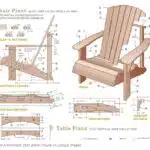
Good woodworking starts before you pick up a tool. A detailed plan — whether a sketch on paper or a full set of blueprints — lets you spot problems before they become expensive mistakes in lumber.
At a minimum, your plan should include a cut list (every piece with its dimensions), a materials list (how much lumber to buy), and a simple assembly diagram showing how the pieces fit together. Working from a plan also helps you calculate exactly how much material you need — which means fewer trips to the lumber yard and less wasted wood.
For beginners, using professionally written plans is the most practical starting point. A good plan walks you through every step in the right order, with cut lists and materials lists already worked out. Our Ted’s Woodworking review covers one of the most comprehensive plan libraries available for woodworkers at every level.
9. Precision measuring and marking
In woodworking, the saying is measure twice, cut once — and it’s good advice. Most beginner mistakes trace back to measurement errors made before the saw hits the wood.
The right tools for accurate measurement
A quality tape measure and a combination square cover most of what a beginner needs. The combination square is particularly versatile — it marks 90-degree angles, checks for square during assembly, and sets consistent depths for dadoes and rabbets.
Replace pencil lines with a marking knife for layout. A knife severs the wood fibres and creates a physical groove that your saw blade or chisel can register against. The result is measurably more accurate cuts than any pencil line allows.
Common measuring mistakes to avoid
Always measure from the same reference point on each piece when making repetitive cuts — don’t measure from the end of one piece, then the end of another. Cumulative error adds up fast. Use a story stick or a piece of scrap set to your dimension to transfer measurements repeatedly without re-measuring each time.
10. Problem-solving and adaptability
Every woodworker — beginner and expert alike — makes mistakes. The difference between a frustrated beginner and a confident one is knowing that mistakes are fixable and that problem-solving is part of the craft.
Common beginner problems and fixes
Gaps in joints can often be filled with a mixture of wood glue and fine sawdust from the same species — the patch blends in remarkably well under a finish. A joint that’s slightly out of square can sometimes be pulled back into line with careful clamping before the glue sets. A tearout patch on a surface can often be addressed with a cabinet scraper, which removes a finer shaving than sandpaper and doesn’t leave cross-grain scratches.
Stay connected to the woodworking community
The woodworking community is one of the most generous and helpful craft communities you’ll find. Forums like Sawmill Creek, YouTube channels from makers like Steve Ramsey and The Wood Whisperer, and local woodworking clubs are all excellent resources for learning new techniques and getting advice when you’re stuck. No one figures out woodworking entirely alone — and you don’t have to either.
Woodworking is a journey as much as it is a destination. Each project builds upon the last, reflecting your evolving skill set and passion. Keep your saws sharp, your mind open, and your creativity unbound.
Put these woodworking basics into practice
The woodworking basics for beginners covered in this guide are the foundation of every project you’ll ever build. Understanding wood types, grain, joinery, finishing, and safety gives you the mental toolkit to approach any build with confidence.
The best way to reinforce these basics is to start building. Pick a simple project — a shelf, a box, a small table — find a well-written plan, and work through it methodically. Every project will teach you something new about the craft.
For a library of over 16,000 step-by-step plans at every skill level, read our Ted’s Woodworking review. For the tools you’ll need to get started, read our essential woodworking tools guide.